Introduction: Music and Football, The Universal Language of Afrobeats and Football
Football and Afrobeats share the same DNA—rhythm, energy, and community. Both are built on joy, movement, and togetherness. On the streets of Lagos, Accra, or Johannesburg, kids grow up playing football with speakers blasting the latest Afrobeats hits, every dribble and goal synced to the beat. The same spirit carries into professional arenas, where football and music are inseparable companions in shaping African identity and global culture.
From local pitches to the world’s grandest stages, Afrobeats has become more than just a soundtrack—it’s a lifestyle that mirrors the beautiful game. Football thrives on passion, and Afrobeats thrives on vibe; together they create a cultural wave that connects fans, players, and artists. When a stadium erupts in song or when a footballer celebrates with a dance born from Lagos nightlife, you see the two worlds blending seamlessly.
What makes this bond so powerful is its universality. Just as football is the world’s most popular sport, Afrobeats has become one of the world’s fastest-growing music genres. They both cross borders with ease, needing no translation—whether it’s a Brazilian fan singing along to Burna Boy or a French teenager copying Osimhen’s celebration to an Asake track. In both football and Afrobeats, the language is movement, the language is rhythm.
Today, Afrobeats isn’t just African background music—it has taken center stage in global football culture. It’s in locker rooms where stars prepare for battle, in goal celebrations that trend worldwide, in FIFA video games played by millions, and on the biggest stages like the World Cup Final, the Champions League Final, and the Ballon d’Or. Just like African footballers breaking boundaries in Europe’s top leagues, Afrobeats artists are carrying their sound to the world, ensuring that when the whistle blows, the beat follows. The synergy between Afrobeats and Football is reshaping the cultural narrative.
Afrobeats in the Locker Room: Players Stay Connected to Home
For African players in Europe, Afrobeats is more than music—it’s identity. It reminds them of home, of family, and of the street energy that first nurtured their love for the game. In a foreign country, stepping into the locker room with Burna Boy, Wizkid, or Asake booming through the speakers can feel like carrying Lagos, Accra, or Dakar into London, Paris, or Munich. It’s not just sound—it’s comfort, culture, and connection.
Stars like Victor Osimhen frequently post videos vibing to Asake’s street anthems, reinforcing his image as not just a footballer, but a cultural figure rooted in Nigeria’s vibrant youth movement. Sadio Mané, humble yet fierce on the pitch, has admitted that Burna Boy’s music fuels his pre-match mindset, helping him find rhythm before a big game. For them, Afrobeats isn’t just hype music—it’s a bridge between the continent that raised them and the European stadiums where they shine.
But Afrobeats has grown beyond African circles in football. The genre’s infectious rhythm has turned dressing rooms into global culture hubs. Marcus Rashford has been seen sharing playlists filled with Wizkid and Davido, while Paul Pogba often posts videos dancing to Afrobeats hits. Their influence means entire squads, made up of players from South America, Europe, and Asia, end up soaking in African sounds. What started as a cultural anchor for African stars has become shared team energy—music that unites rather than divides.
This shift highlights the universal pull of Afrobeats. Just like football, the genre doesn’t need translation—only feeling. Whether it’s motivating players before kick-off, soundtracking celebrations after a win, or lifting spirits during recovery, Afrobeats has cemented its role in the locker room. It’s not just background music anymore—it’s part of the game itself, shaping mood, identity, and team culture.
The intersection of Afrobeats and Football showcases the power of music to transcend borders and unite people from diverse backgrounds. This vibrant fusion of rhythm and sport is a testament to the evolving landscape of global culture.
Goal Celebrations Powered by Afrobeats Dance Moves
Football celebrations have always been about joy, but in the last decade they’ve also become mini-Afrobeats concerts on the pitch. The influence of African dance trends has spread from the streets of Lagos and Accra straight into the Premier League, La Liga, Serie A, and beyond. Every goal is now an opportunity not just to celebrate, but to showcase rhythm, culture, and personality.
Few players embodied this better than Paul Pogba, who introduced Afrobeats-inspired moves like the shaku-shaku and gwara gwara into global football. His celebrations often went viral, inspiring kids in France, Nigeria, and even Asia to copy his dances after scoring in their own games. Pogba wasn’t just scoring goals—he was exporting African culture through movement.
National teams also played a big role. The Super Eagles of Nigeria, famous for their stylish flair, made the zanku dance a trademark during AFCON celebrations. Each goal turned into a performance, blending unity, confidence, and music-inspired joy. Their celebrations became so iconic that even non-Nigerian fans tried the moves, proving how Afrobeats dances had transcended borders.
The new generation has carried the torch. Victor Osimhen is often spotted vibing to Afrobeats rhythms after goals, his playful movements matching the energy of Nigerian street beats. Samuel Chukwueze has celebrated in La Liga with TikTok-inspired Afrobeats dances, bringing Nigerian youth culture to Spanish football. Mohammed Kudus, the Ghanaian playmaker, once pulled out a dance celebration to an Afrobeats track after scoring for Ajax, instantly going viral across Africa. Even younger talents coming through now see a goal as more than just numbers on the board—it’s a stage for rhythm.
But it’s not just African stars keeping the beat alive. Afrobeats-inspired moves have been adopted worldwide. Antoine Griezmann made headlines with his gwara gwara dance at the 2018 World Cup, borrowing straight from African pop culture. Jesse Lingard turned TikTok-style dances into his trademark at Manchester United, often syncing moves that originated from Afrobeats tracks. Even players like Pierre-Emerick Aubameyang—though Gabonese—added extra flair by celebrating with global Afrobeats-style dances that resonated with fans across continents.
And with TikTok hits like Rema’s “Calm Down” and Fireboy’s “Peru”, the line between football pitches and dance floors has blurred even further. These songs spark dances that players bring onto the pitch, making football a true performance art where sport and sound merge. Football goals today don’t just win matches—they set cultural trends, powered by Afrobeats.
The Rise of Afrobeats Street Pop: How Street Culture is Taking Over the Mainstream
Afrobeats on the Biggest Stages: From UEFA to the World Cup
What once started in local clubs and street corners has now climbed onto football’s most prestigious stages. Afrobeats has broken barriers, no longer confined to playlists and locker rooms but commanding the same spotlight as football’s greatest events. These moments are not just performances—they are history-making crossovers that showcase Africa’s rhythm to the entire world.
In 2022, the world witnessed one of Afrobeats’ defining moments when Davido performed “Hayya Hayya (Better Together)” at the FIFA World Cup Final in Qatar. The song, an official anthem for the tournament, echoed through the stadium as billions tuned in worldwide. For Afrobeats, this wasn’t just entertainment—it was a symbolic arrival on football’s grandest stage, affirming the genre’s global reach.
The following year, another milestone arrived. Burna Boy became the first-ever Afrobeats artist to headline the UEFA Champions League Final in Istanbul (2023). Performing in front of millions across the globe, Burna fused African sound with Europe’s most prestigious football tournament. His performance wasn’t just about music—it was a declaration that Afrobeats belongs at the very heart of global sporting culture.
Then came Rema’s crowning moment in Paris at the 2023 Ballon d’Or. Performing his global smash hit “Calm Down” as Lionel Messi lifted an eighth Ballon d’Or, Rema placed Afrobeats alongside football’s greatest icon. The symbolism was clear: Africa’s music and football heritage are no longer on the sidelines—they stand together on the world’s center stage.
These landmark moments prove Afrobeats isn’t just part of football culture—it has become an essential piece of the spectacle, elevating ceremonies, uniting fans, and exporting African identity through the universal language of rhythm.
Afrobeats Stars Linking Up With Football Clubs
The bond between Afrobeats and football goes beyond playlists and performances—artists themselves are now welcomed into the football world:
-
Rema at FC Barcelona (2023)
The Afrobeats sensation toured the Camp Nou, met Barça players, and even swapped shirts. It was a viral moment that showed how global stars in music and sport recognize each other.
-
Burna Boy at Manchester United (2021)
Burna Boy teamed up with Manchester United when his song “Glory, Glory Man United” was remixed to celebrate the club’s kit launch. He later performed in Manchester and was seen hanging out with players.
-
Davido at Chelsea (2022)
A well-known Chelsea supporter, Davido has visited Stamford Bridge several times, even linking up with players. His presence at games always trends across football and music Twitter.
-
Wizkid at Arsenal (2024)
Wizkid visited Arsenal’s Emirates stadium, where he’s been pictured with stars like Bukayo Saka. Arsenal fans even jokingly call him their “good luck charm.”
-
Mr Eazi at Crystal Palace (2025)
Nigerian musician Mr Eazi celebrated with the Crystal Palace football club players after their win in the FA Cup final on May 21, 2025, posing for photos with the trophy and team members to mark the major title win. The win was Crystal Palace’s first major trophy in their history.
-
Skales at FC Barcelona (2025)
Skales entered the FC Barcelona spotlight after Spanish football star Lamine Yamal went viral dancing to Skales’ 2014 song “Shake Body,” leading to a collaboration where Skales performed live at the team’s private Copa del Rey title party. Following this, Skales also met other Barcelona players, including Alejandro Balde and Barcelona president Joan Laporta, who gave his approval to the song. Skales later returned to Barcelona to promote his new track, “Dance Like Lamine Yamal,” with a music video filmed there.
-
Patoranking at Borussia Dortmund (2025)
Patoranking’s visit to Borussia Dortmund saw him tour the facilities, meet players, and step onto the Signal Iduna Park pitch—another moment showing Afrobeats’ growing ties with European football.
From Camp Nou to Old Trafford, Afrobeats stars are now treated like football royalty. These interactions highlight how much the genre has become part of the football lifestyle, with artists celebrated not just by fans but also by the world’s biggest clubs.
Afrobeats Stars Linking Up With Football Players
The connection between Afrobeats and football isn’t just about stadium soundtracks or goal celebrations—it’s deeply personal. Both worlds thrive on youth culture, energy, and global reach, so it’s no surprise that players and artists naturally gravitate towards each other. These bonds are forged in studios, at sold-out concerts, or across social media, where millions of fans watch their worlds collide.
Afrobeats in 2025: Why West African Music is Taking Over the World
-
Wizkid & Bukayo Saka
Arsenal star Bukayo Saka has been spotted vibing to Wizkid’s tracks on several occasions, and the two share mutual admiration. For a young player born in London to Nigerian parents, connecting with Wizkid—arguably Nigeria’s biggest global music export—symbolizes the blend of identity and inspiration.
-
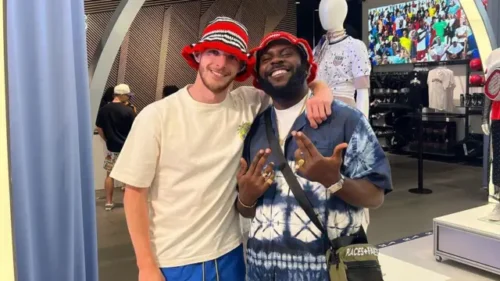
Odumodublvck and Declan Rice
Nigerian rap sensation Odumodublvck breakout hit “Declan Rice” didn’t just dominate Nigerian airwaves—it created a cultural moment that reached the Premier League. The track, named after the English midfielder, became so big that Declan Rice himself embraced it, even celebrating it after matches. Their eventual link-up—Rice meeting Odumodublvck in person—was more than a fan moment; it was Afrobeats crossing into English football culture in real time. It showed how a song born in Abuja could echo through London stadiums, turning music into a bridge between two worlds.
-
Davido & Memphis Depay
Among the closest music-football friendships is the one between Davido and Dutch forward Memphis Depay (of Ghanaian descent). Davido has attended Depay’s private parties in Europe, while Depay frequently vibes to Davido’s hits on social media. Their friendship shows how Afrobeats bridges cultural heritage with footballing success in Europe.
-
Burna Boy & Paul Pogba
Burna Boy and Paul Pogba share one of the most visible music-football friendships. Pogba has attended Burna Boy’s concerts—dancing freely in the crowd—while Burna has given him a shout out on stage in front of thousands. Their connection is so well known that Pogba’s signature dance moves often mirror the rhythms of Burna’s tracks.
10 Times Burna Boy Shocked The World: Afrobeats Royalty
-
Asake & Victor Osimhen
Nigeria’s street king of Afrobeats and the country’s talismanic striker share more than just fame—they share cultural pride. Osimhen regularly posts Asake’s music on his Instagram stories, while Asake publicly celebrates Osimhen’s football achievements. For fans, their bond represents the dream of Lagos youth: excelling in football or music, but always staying rooted in street culture.
-
Rema & Achraf Hakimi
After Rema’s “Calm Down” became a global anthem, PSG’s Achraf Hakimi linked up with him in Paris. Their meeting went viral, with pictures of the Moroccan defender and Nigerian hitmaker circulating widely online. It was a reminder of how Afrobeats has become a unifying language across Africa and beyond.
-
Tiwa Savage & Alex Iwobi
Tiwa Savage, Nigeria’s Afrobeats queen, and Everton midfielder Alex Iwobi have appeared together at cultural events, highlighting the shared responsibility of representing Nigerian culture abroad. For many young Nigerians, they symbolize how music and football serve as parallel paths to global recognition.
These friendships reveal something deeper than casual connections: footballers and Afrobeats artists see themselves as part of the same cultural movement. Both are global ambassadors of African talent, carrying the continent’s rhythm, creativity, and excellence onto stages and pitches that reach millions around the world.
Football Stars at Afrobeats Concerts Abroad
The love flows both ways—while Afrobeats artists are welcomed into stadiums, football stars also make time to show up at their concerts around the globe. These moments highlight just how deeply music and football are intertwined, each feeding off the energy of the other. From Paul Pogba dancing at Burna Boy’s shows, to the Bayern Munich squad vibing to Wizkid, and stars like Antonio Rüdiger, Hakim Ziyech, Memphis Depay, Achraf Hakimi, and Wilfried Zaha turning up at performances by Afrobeats heavyweights such as Davido, Stonebwoy, and Rema, the crossover is undeniable. It’s not just about fandom—it’s a cultural exchange, where footballers celebrate the very music that inspires their own performances on the pitch.
These nights show that Afrobeats concerts abroad aren’t just for fans—they’ve become cultural hotspots where the worlds of music and football collide in full view. Under the bright lights of arenas from London to Paris, football stars blend seamlessly into the crowd, singing along, dancing, and sometimes even joining the artists on stage.
When Pogba turns up at a Burna Boy show, or Hakimi and Ziyech are spotted at a Wizkid concert, it’s more than celebrity appearances—it’s a celebration of shared identity and rhythm. These moments remind us that both Afrobeats and football are about performance, community, and passion, and when they meet, the energy is electric. They create snapshots of global culture, where fans, players, and artists all celebrate together, blurring the line between the pitch and the stage.
Fans Bring the Beat: Afrobeats in the Stands
From AFCON stadiums in Ivory Coast where fans roared along to Kizz Daniel’s “Buga”, to bustling watch parties in London and Paris blasting Davido’s “Fall”, supporters are carrying Afrobeats into football culture with unmatched passion. The music doesn’t just set the mood—it becomes part of the atmosphere, echoing through stands and public squares, uniting strangers in rhythm. Whether it’s the booming chorus of a hit song or the syncopated beat of a drumline, Afrobeats injects a pulse that turns football gatherings into cultural celebrations.
Terrace chants have also started to borrow directly from Afrobeats hooks, giving traditional football songs a fresh African twist. At Ajax, fans have been heard remixing Afrobeats-inspired rhythms into their chants, while in England, Arsenal supporters in the diaspora often break into Wizkid or Burna Boy tracks during fan events. Even PSG fans in Paris have celebrated Hakimi and Ziyech with African-inspired beats, proving how easily the genre blends into European football culture.
These moments highlight that music and football speak the same language—one of energy, identity, and community. For many in the diaspora, hearing Afrobeats in stadiums abroad is more than entertainment—it’s a connection to home, blending national pride with the global joy of the beautiful game.
African Songs That Became Football Anthems
Beyond live performances, African songs have secured a permanent place in football culture, echoing through stadium speakers, TV broadcasts, and fan playlists worldwide. Some of these African songs have gone viral after being used for football tournaments, played during half time at stadiums or even used for commercials.
-
K’naan – “Wavin’ Flag” (2010)
The Somali-born anthem of the 2010 FIFA World Cup in South Africa remains one of the most iconic and popular football songs ever.
-
Davido – “Hayya Hayya (Better Together)” (2022)
This song became the official anthem of the FIFA World Cup Final in Qatar, blasting to billions worldwide and cementing Afrobeats as a central part of football’s biggest stage.
-
Kizz Daniel – “Buga” (2022)
This song became a fan favorite at the AFCON 2023, with stadiums erupting in sing-alongs whenever the song came on.
When Arsenal signed Declan Rice in 2023, the club tapped into Afrobeats culture by using Odumodublvck’s hit track “Declan Rice” for his unveiling video. The choice instantly connected with fans, especially Nigerians, turning a standard transfer announcement into a viral cultural moment. It showed how Afrobeats now plays a role in football storytelling, bridging music, identity, and the excitement of the game.
-
Burna Boy – “Last Last” (2022)
This global anthem has been blasted in Premier League warm-ups and echoed through European stadiums, energizing players before kick-off and uniting fans in the stands. Its infectious rhythm transforms matchday atmospheres, proving how Afrobeats has become part of football’s pre-game ritual.
-
Wizkid – “Essence” (2021)
Regularly featured in global sporting playlists, these tracks bridge Afrobeats and football atmospheres—blurring the line between the stadium, the locker room, and the fans’ pre-match rituals.
-
Master KG – “Jerusalema” (2020)
A South African global hit that turned into a football celebration song and viral dance challenge across clubs and stadiums.
-
Rema – “Calm Down” (2022)
Rema’s “Calm Down” is regularly featured in global sporting playlists, bridging Afrobeats and football atmospheres—from stadium speakers to locker-room vibes and fan chants.
These tracks became rallying cries, dance soundtracks, and cultural bridges inside football spaces.
Afrobeats in Football Video Games
The fusion of Afrobeats and football isn’t limited to real stadiums—it thrives in the virtual arenas of EA Sports FIFA, where soundtracks are as influential as the gameplay itself. For millions of gamers worldwide, FIFA has been the gateway to discovering new music, and Afrobeats has steadily carved out its place on these global playlists.
In FIFA 23, “Compromise” by Fireboy DML and Rema stood tall alongside international chart-toppers, bringing Afrobeats to millions of living rooms and gaming consoles across the world. A year earlier, in FIFA 22, “Point and Kill” by Little Simz featuring Obongjayar introduced players to a raw blend of Afro-fusion, highlighting the genre’s growing influence beyond Nigeria. Even tracks not strictly labeled as Afrobeats but inspired by African rhythms have made the cut, such as “Particula” by Major Lazer and DJ Maphorisa, which carried amapiano and Afrobeat influences into FIFA playlists.
For many young fans, especially in Europe and the Americas, the FIFA soundtrack is their first encounter with Afrobeats. The visibility of these songs has not only boosted streaming numbers but also placed African artists in the same global spotlight as mainstream pop and hip-hop stars. Just as football serves as a universal language, these soundtracks prove that Afrobeats is becoming the universal rhythm, uniting gamers and football lovers worldwide.
For many international fans, FIFA was their first introduction to Afrobeats before they heard it on the radio—video games became another bridge connecting African music and football culture.
The Future of Afrobeats and Football
The rise of Afrobeats and African footballers are happening in parallel, creating a cultural wave that’s impossible to ignore. Just as artists like Wizkid, Burna Boy, Tiwa Savage, and Rema dominate global charts and stream counts, African football stars such as Victor Osimhen, Mohamed Salah, and Sadio Mané are lighting up Europe’s biggest leagues. Both worlds carry the same energy—youthful, vibrant, and unapologetically African—making their bond feel natural and inevitable. Music powers the confidence of players, while football amplifies the global reach of the songs, creating a cycle of influence that keeps strengthening.
Looking ahead, the connection is only set to deepen. Imagine a future World Cup opening ceremony headlined by Wizkid, or an AFCON final that doubles as a full-scale music festival with performances from Davido, Ayra Starr, and Asake. These aren’t far-fetched ideas—they’re the next step in a relationship that already sees footballers dancing to Afrobeats after goals and artists linking up with players off the pitch. As both Afrobeats and African football continue their meteoric rise, their partnership will shape not just entertainment, but global culture itself.
Conclusion: Africa’s Rhythm, Football’s Future
Afrobeats isn’t just the soundtrack of African football—it has become the heartbeat of global football culture. From Pogba’s iconic dance celebrations to Rema performing at the Ballon d’Or and visiting Camp Nou, the music has moved from the streets of Lagos to football’s most prestigious stages. Davido at the World Cup Final, Burna Boy headlining the Champions League Final, and Wizkid lighting up the Emirates all prove that African rhythms now sit at the center of the sport’s biggest spectacles.
But it doesn’t stop at performances. Footballers themselves are active players in this cultural movement—dancing to Afrobeats after goals, blasting it in locker rooms, linking up with artists in studios, and even showing up at concerts across Europe and beyond. Meanwhile, fans carry the beat into stadiums and watch parties, remixing chants with Afrobeats hooks and ensuring that the music is not just heard but lived in the terraces. Even in the digital world of FIFA video games, Afrobeats soundtracks now shape how millions of young fans experience football.
The fusion of these two worlds is bigger than sport or music—it’s a reflection of Africa’s global influence. Just like hip-hop and basketball defined a generation in America, Afrobeats and football are writing Africa’s cultural story on a worldwide stage. The pitch and the stage now share the same rhythm, the same energy, the same community. And as the beat goes on, one thing is certain: the future of football will keep dancing to Afrobeats.